
On September 4, lululemon reported its fiscal 2026 second-quarter results.
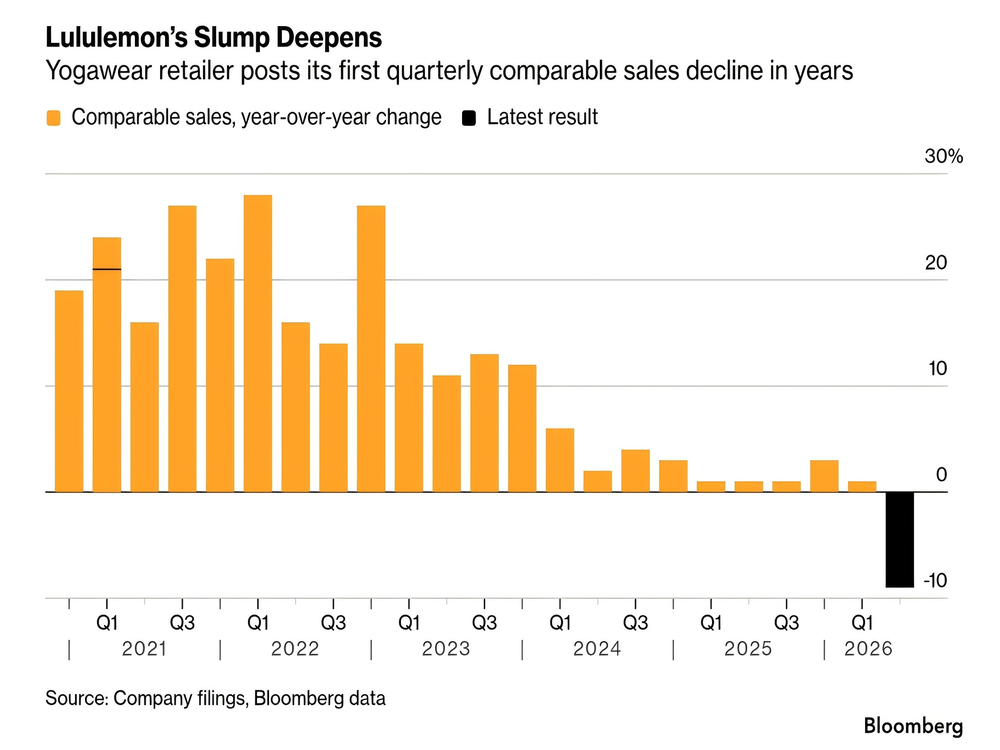
Revenue came in at $2.416 billion, down 4% year over year. North America fell 8%. Mainland China grew 4% on a reported basis, but declined 2% in constant currency, compared with 23% growth in the previous quarter. Full-year guidance was cut again, this time to $10.35–10.5 billion.
The stock fell sharply after hours.
The quarter was weak, but the more interesting question is whether this is simply a temporary slowdown or something more structural.
The signs point to the latter.
lululemon is dealing with pressure in North America and China at the same time. Comparable sales have turned negative, guidance has been reduced twice, and the product mix is shifting away from some of the categories that defined the brand in the first place.
That matters because lululemon was built on one of the clearest category stories in modern sportswear.
It took yoga apparel, especially leggings, and turned it into a global lifestyle business.
The challenge now is what happens after that category reaches maturity.
lululemon’s success came from more than technical fabric or fit.
It created a category that customers understood immediately. The product was functional, flattering, comfortable, easy to wear often and easy to buy repeatedly. Over time, yoga apparel became part of a broader lifestyle identity.
That gave the brand exceptional pricing power.
For years, customers were willing to pay premium prices without waiting for promotions. In practical terms, lululemon built something more valuable than a successful product line: it built a position in the customer’s mind.
But a strong category can only carry growth so far.
Once the target customer already owns several pairs of leggings, the next purchase becomes harder to earn. Replacement demand starts to matter more than first-time adoption. Meanwhile, competitors enter the market and consumers become more selective.
This is where vertical brands usually have to change.
Canada Goose faced a similar issue from another angle. Its core strength was premium down outerwear, a high-value category with obvious seasonality and relatively low purchase frequency. To keep growing, it had to move into lighter outerwear, knitwear, footwear and accessories.
The principle is the same.
The brand has to move beyond the product that made it famous without weakening the reason people trusted it in the first place.
In North America, lululemon is seeing weaker traffic and lower conversion, while demand for traditional tight leggings has softened. Consumers are moving toward looser, more everyday silhouettes.
In China, the slowdown has been even more abrupt. Growth moved from 23% in constant currency in the previous quarter to a 2% decline.
At the same time, competition is getting denser.
Alo is expanding internationally. NikeSKIMS is building out women’s performance and studio categories. On is moving beyond running into yoga, Pilates and broader studio wear. Local Chinese brands are also improving quickly in fit, fabric and product storytelling.
The implication is fairly clear: lululemon is no longer operating in a category it can define on its own.
The question has shifted from “how fast can yoga apparel grow?” to “what kind of brand does lululemon want to become next?”
That is a harder question.
The obvious response to maturity is category expansion.
But adding categories and building a second growth engine are not the same thing.
A new product area only becomes meaningful when customers can understand why it belongs to the brand.
For lululemon, expansion from yoga into studio, running, training, commuting, travel and light outdoor makes sense because those scenes remain close to the brand’s core strengths: comfort, movement, fabric performance and everyday wearability.
The new market also has to be large enough to matter.
Moving from yoga into a broader active-lifestyle wardrobe creates much more room than simply adding another variation of leggings.
And most importantly, the product still needs a reason to exist.
That reason might come from fabric, fit, construction, functionality or a new way of wearing the garment. Without that, expansion becomes assortment growth rather than brand growth.
This is where product development becomes critical.
From a product and supply-chain perspective, the direction is already visible.
The boundaries between yoga, running, commuting, travel and light outdoor are becoming less rigid.
Consumers increasingly want garments that perform well but do not look overly technical. A pair of pants should work in movement, on a flight and in the city. A jacket can offer stretch, wind protection and storage without looking like outdoor equipment.
That is why categories such as wide-leg active pants, lightweight outerwear, studio jackets, travel pants and soft-shell hybrids are attracting more attention.
This changes how brands develop product.
It is no longer enough to optimize for a single sport or use case.
Fabric performance, fit, mobility, comfort, visual identity and daily wearability now have to be solved together.
For suppliers, that moves the conversation upstream.
Fashion and performance used to sit in separate development systems.
That distinction is fading.
Sports brands want more fashion relevance and lifestyle appeal. Fashion brands want better functionality and performance credibility.
As a result, more brands are bringing suppliers and ODM partners into the process earlier.
The work now starts before the tech pack.
Fabric direction, silhouette, fit, functional construction, sample validation and wear scenarios are increasingly part of the same development conversation.
For brands in transition, this matters because the next growth curve is rarely found in one meeting or one idea.
It is found through repeated product development, testing and refinement.
The partner that can reduce trial cost, shorten development cycles and translate a new consumer scene into a commercially viable product becomes more valuable.
EVER GLORY has worked with international apparel brands across different stages of the market.
Our earlier experience in fast fashion and branded apparel gave us a strong foundation in merchandising, product development and speed to market. Since 2018, we have invested more heavily in sportswear, outdoor and functional apparel.
Those two backgrounds now increasingly overlap.
Many of the most interesting product opportunities today sit between fashion and function.
For brands exploring new growth areas, our role is not simply to provide manufacturing capacity. We can join the development process earlier, from trend and fabric direction through fit development, functional construction, sample testing and small-batch validation.
For an established sports brand, that may mean extending into commuting, travel, light outdoor or broader lifestyle categories.
For a fashion brand, it may mean building real performance capability into the product rather than adding functional details at the surface.
And for emerging brands, the supply chain itself can become part of the innovation process.
lululemon’s current challenge is not unique.
Every brand built around one powerful category eventually reaches a point where the category alone is no longer enough.
For brands, that is the next growth question.
For suppliers, it is a chance to move from execution to co-development.

 EN
EN