In September 2026, U.S. denim maker Cone Denim said it would end denim production in China by the close of 2026, part of a broader realignment of its global manufacturing footprint.
The move closes the company's mill in Jiaxing, Zhejiang, which has been operating since 2007 — nearly two decades.
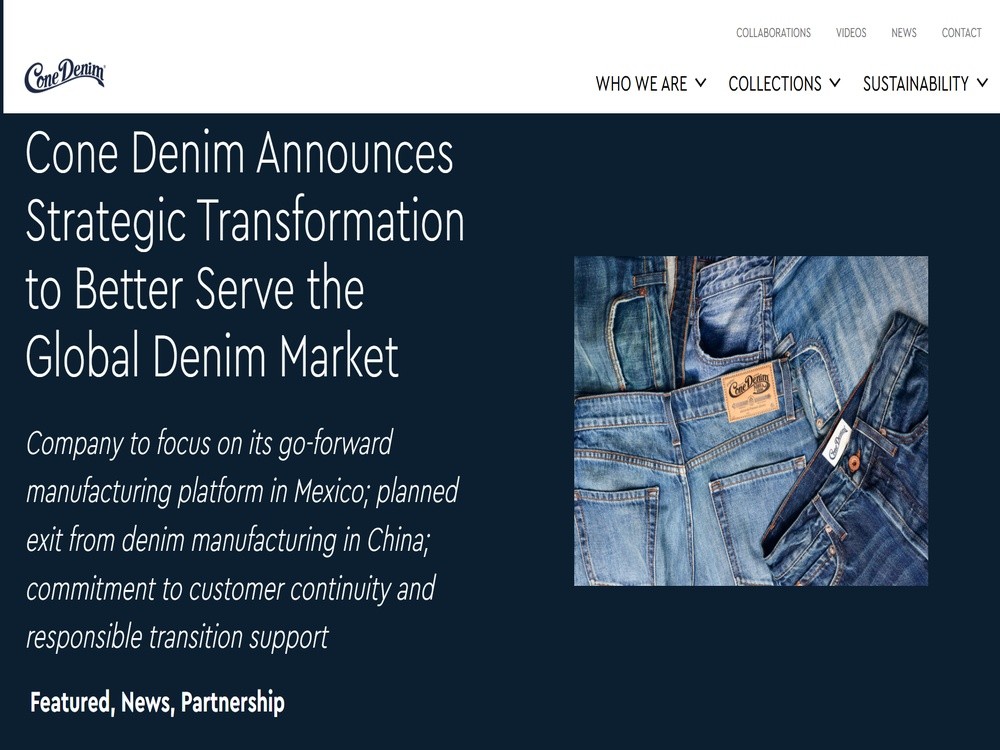
Cone Denim is not just another fabric supplier.
Founded in 1891, Cone Denim is one of the world's longest-standing denim manufacturers. Levi's has sourced its fabrics since 1915. In the denim world, the company is more than a supplier of capacity: it carries decades of fabric expertise and long-standing ties with global brands.
The striking part is that Jiaxing was not a rundown plant that had simply stopped receiving investment. As recently as 2024, the mill was working on a rooftop solar project. It had also brought in water-saving technologies such as ozone finishing to lift production efficiency and sustainability performance. None of that changed the company's decision to reshape its global network.
Cone Denim said the decision followed a broad review of global market conditions, customer sourcing requirements and its own manufacturing footprint. Economic conditions, the trade environment and shifting supply chains all weighed on the long-term competitiveness of its China operation.
So this closure is about more than a foreign-owned mill leaving China.
The bigger question is where the next wave of capacity lands.
For more than a decade, Vietnam's apparel industry has run on a familiar supply chain model:
China Fabric -> Vietnam Garment -> European and U.S. Markets
Vietnam built strong garment manufacturing capabilities, while China supplied most of the yarn, fabric, dyeing and finishing work, and trims.
Even as garment production moved into Vietnam, the upstream chain stayed closely tied to China.
That model is now starting to change.
As Vietnam's garment base grows, more Chinese textile companies are putting upstream capacity directly in the country.
Previously:
China Fabric -> Vietnam Garment -> Global Market
Now emerging:
Vietnam Fabric -> Vietnam Garment -> Global Market
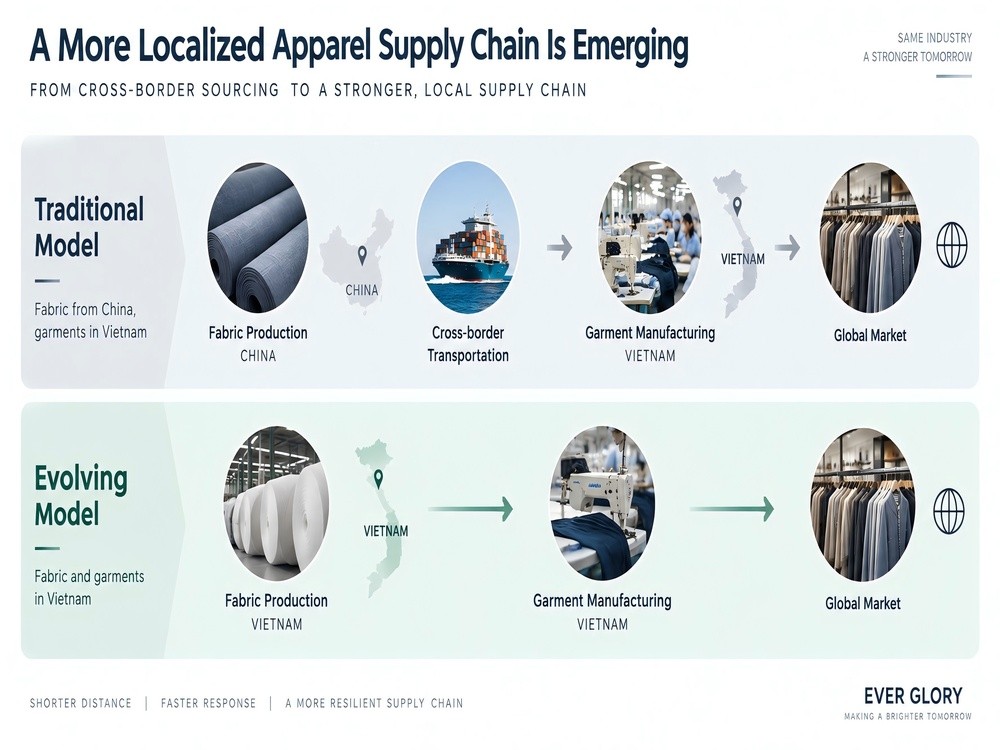
Caption:
Vietnam's garment industry is gradually shifting from cross-border sourcing toward a more localized textile supply chain.
That does not mean Vietnam is just taking over China's textile supply chain.
But what we are seeing is a different kind of change:
The equipment, technical expertise, management systems, fabric development know-how and supply chain capabilities that China's textile industry built over several decades are now extending into Vietnam alongside garment manufacturing.
Northern Vietnam has become one of the most important regions to watch this change unfold.
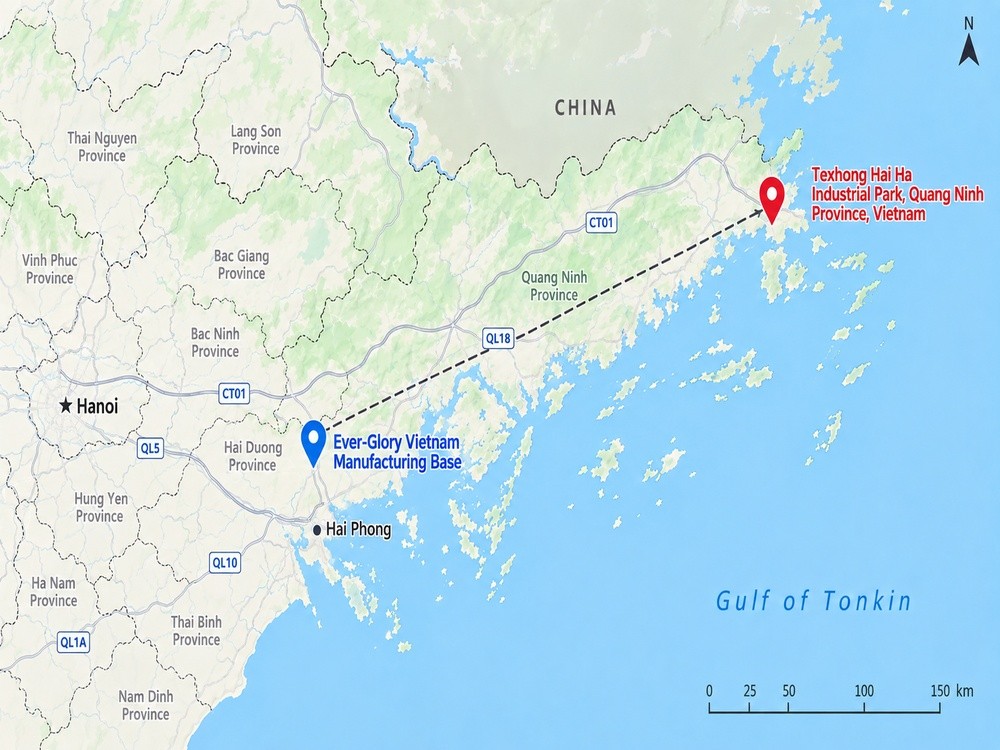
In Quang Ninh Province, northern Vietnam, Texhong Hai Ha Industrial Park is emerging as a key cluster in the localization of the textile supply chain.
Texhong International Group, a Chinese textile company, invested in and developed the park.
The fully developed first phase covers roughly 660 hectares and has drawn 27 investment projects, with registered foreign investment approaching US$3 billion.
Unlike a conventional industrial park, Hai Ha was planned around the textile value chain from the outset.
Spinning, weaving, dyeing, denim, woven and knitted fabrics and related services — a growing mix of upstream and downstream companies is clustering in one place.
For textile manufacturers, the park's centralized water and steam supply and industrial wastewater treatment stand out. These systems give dyeing, printing and finishing operations the environmental, energy and wastewater conditions they need.
The cluster is still expanding.
New projects in yarn, synthetic fabrics, performance outdoor fabrics and protective materials keep coming in. Northern Vietnam, in short, is moving beyond garment manufacturing into a wider range of upstream textile capabilities.
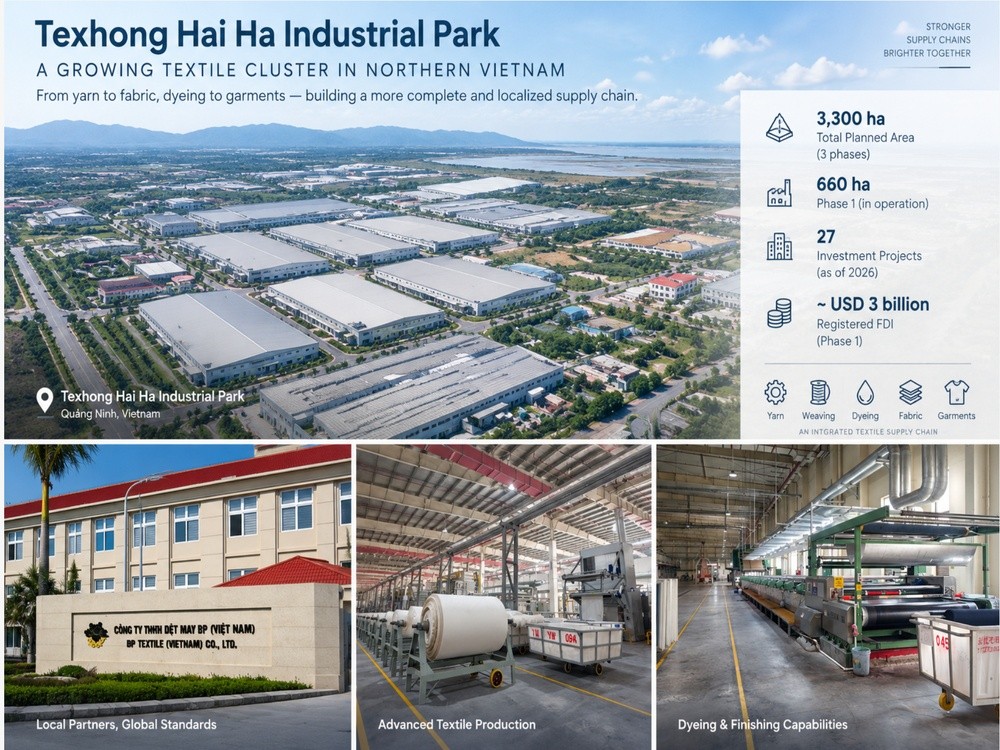
Caption:
Texhong Hai Ha Industrial Park in northern Vietnam is developing into an integrated textile cluster spanning yarn, weaving, dyeing and fabric production.
This is a real upgrade for Vietnam's textile and apparel industry:
Vietnam is moving from a place where garments can be made to one where a fuller apparel supply chain can be organized.
If 'China + 1' summed up the last decade, a different word may matter more in the years ahead:
Localization.
Moving garment production to Vietnam does not, by itself, create a localized supply chain.
If fabrics are still made in China and shipped across the border, fabric approval, production, transport, inventory and replenishment all keep running on a long cycle.
That changes once fabric mills, dyeing and finishing operations and trim suppliers also set up in Vietnam.
With fabric production sitting closer to garment factories, development and replenishment speed up, and cross-border transport and inventory pressure ease.
Vietnam's competitiveness in the next phase may therefore depend on more than labor costs or trade advantages.
What matters is this:
Can Vietnam grow from a garment manufacturing base into a broader apparel supply chain base?
For EVER GLORY, this is not just a trend we watch from afar.
Here is the part that matters most to us: several of the Chinese textile and fabric companies now operating in Hai Ha are suppliers we already work with.
We have built long-term relationships with them over many years of working together in China.
Through that work, we have developed a shared understanding of product standards, fabric quality, development processes and what international brands expect.
As these suppliers extend into Vietnam, our partnerships can follow.
In early September 2026, the EVER GLORY team visited Hai Ha Industrial Park and local fabric suppliers in northern Vietnam.
The trip focused on local fabric manufacturing, weaving, dyeing and finishing and the supporting capabilities around them. We also sat down with several supply chain partners for in-depth talks about future local fabric sourcing in Vietnam.
The visit opened a direct channel with these partners, and we have started discussing more concrete ways to cooperate.
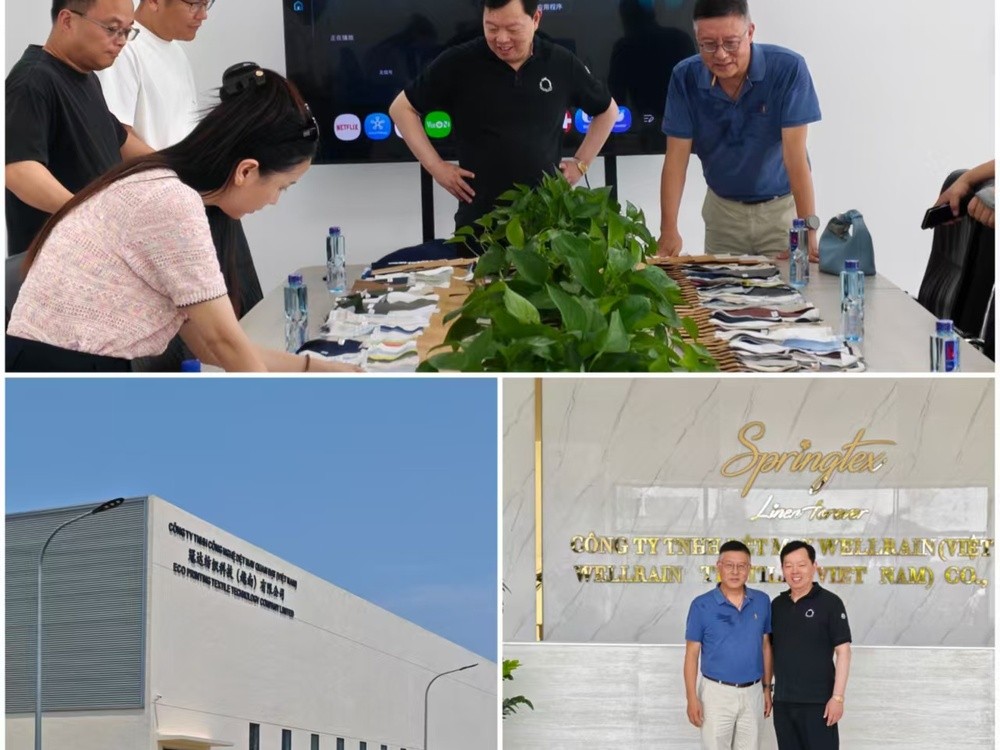
Caption:
EVER GLORY team visiting textile partners at Hai Ha Industrial Park, northern Vietnam, September 2026.
This is the approach EVER GLORY is taking to supply chain localization in Vietnam.
We are not starting from zero in Vietnam, building a supplier base we barely know.
Instead, we are building on supply chain relationships developed over many years in China. With Chinese fabric partners that now have operations in Vietnam, we want to extend proven working relationships, quality standards and development experience into the market.
What we plan to build on next is the link between:
EVER GLORY Vietnam Manufacturing x Hai Ha Local Fabric Supply
The goal is tighter coordination between our Vietnam factory and the fabric producers in Hai Ha Industrial Park — upstream and downstream working together.
Our objective is to start using locally sourced Vietnamese fabrics in selected orders from 2027.
For selected products, this will gradually shift the supply chain from:
China Fabric -> Vietnam Garment
to:
Vietnam Fabric -> Vietnam Garment
For customers, the supply chain stays just as capable on quality and development, but transport distances and lead times get shorter, orders respond faster and the chain is more resilient.
Local fabric sourcing is not the end of the road.
EVER GLORY is also planning a new sample and product development center in Vietnam, with construction expected to begin in 2027.
Once these capabilities are in place, we want to push localization further upstream, toward the front end of the chain.
Over time, more of the work — interpreting customer needs, developing products, developing and sourcing fabrics, making samples, manufacturing garments — can be done directly in Vietnam.
The direction we are working toward is:
Local Development -> Local Fabric -> Local Manufacturing
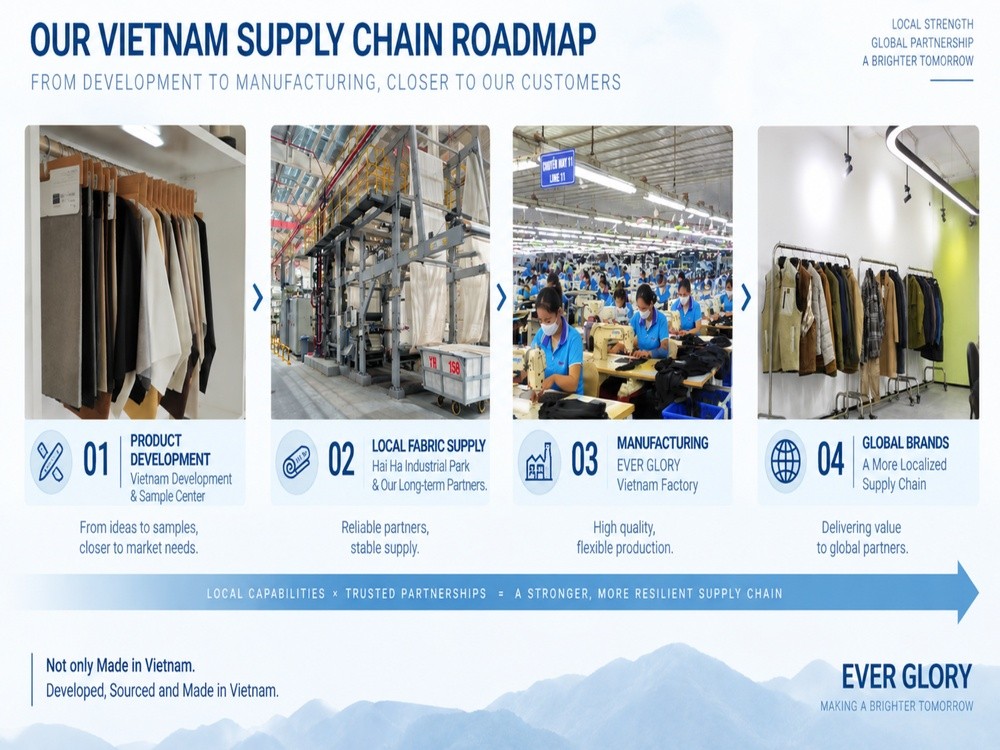
Caption:
From long-term partnerships in China to deeper supply chain integration in Vietnam.
The closure of Cone Denim's Jiaxing mill is one example of how the global textile industry's manufacturing footprint is changing.
Look south from China, though, and another shift is happening at the same time:
Some production capacity is leaving China, even as the technology, equipment, management experience and supply chain capabilities built by China's textile industry move into new manufacturing regions.
Vietnam is taking on more than extra garment orders.
Fabric production, dyeing and finishing, trims and product development are also starting to cluster locally.
This may prove to be the more significant shift in the next phase of Asia's apparel supply chain:
A move beyond the global distribution of manufacturing capacity toward more regionalized and localized supply chains.
EVER GLORY has already started taking part in this transition.
By combining our existing manufacturing capabilities in Vietnam with long-standing Chinese supply chain partners, we are working to expand local fabric sourcing, sampling and product development. Our aim is that customers get more than a production base in Vietnam — they get a more complete local supply capability covering development, materials and manufacturing.
We are not looking for a new supply chain. We are bringing partnerships we have built over many years into a new manufacturing base.
Not only Made in Vietnam.
Developed, Sourced and Made in Vietnam.

 EN
EN