In 2026, sustainability rules in Europe started to move from policy language into day-to-day business decisions.
For apparel brands and suppliers, three barriers are taking shape at the same time:
chemical compliance, product data and inventory responsibility.
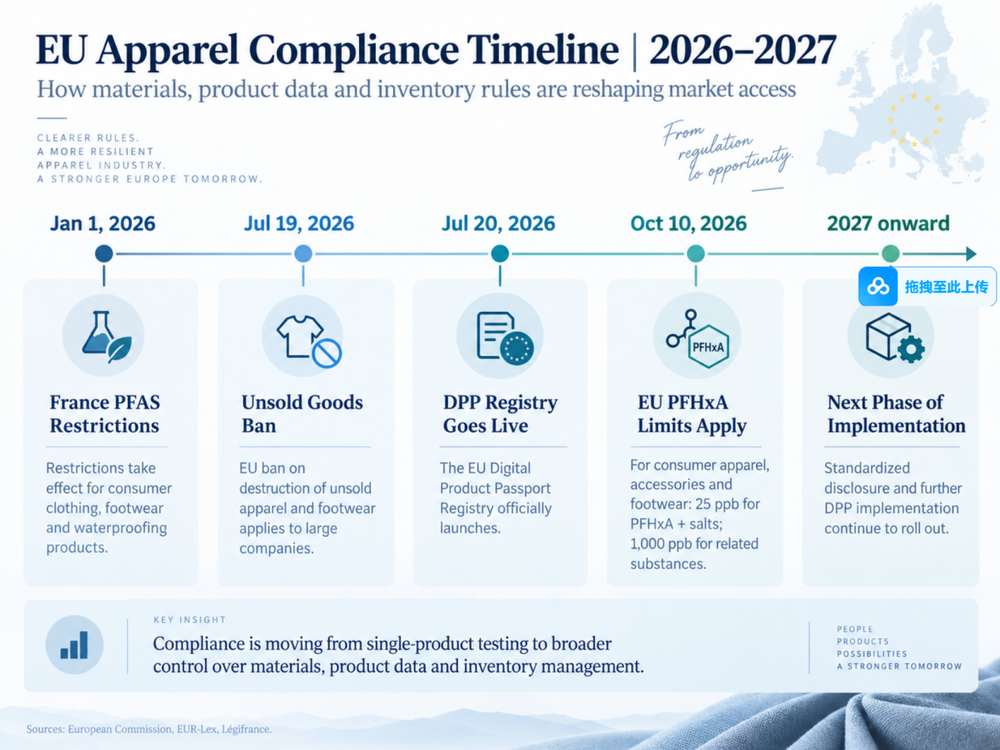
France's PFAS restrictions are already in force. The EU's PFHxA limits for consumer apparel and footwear take effect in October. The Digital Product Passport infrastructure is now live. Large companies across the EU are no longer allowed to routinely destroy unsold clothing and footwear.
These rules look different on paper, but they point in the same direction.
Europe is moving beyond the question of whether the finished product passes a final test.
The new question is:
How was the product made, what materials went into it, can the data be traced, and what happens to it if it does not sell?
For apparel supply chains, compliance now works as a system, not just a certificate.
The three rules arrive through different channels, but each pushes compliance deeper into product development, sourcing and lifecycle management.
2026 is the year compliance moves into execution
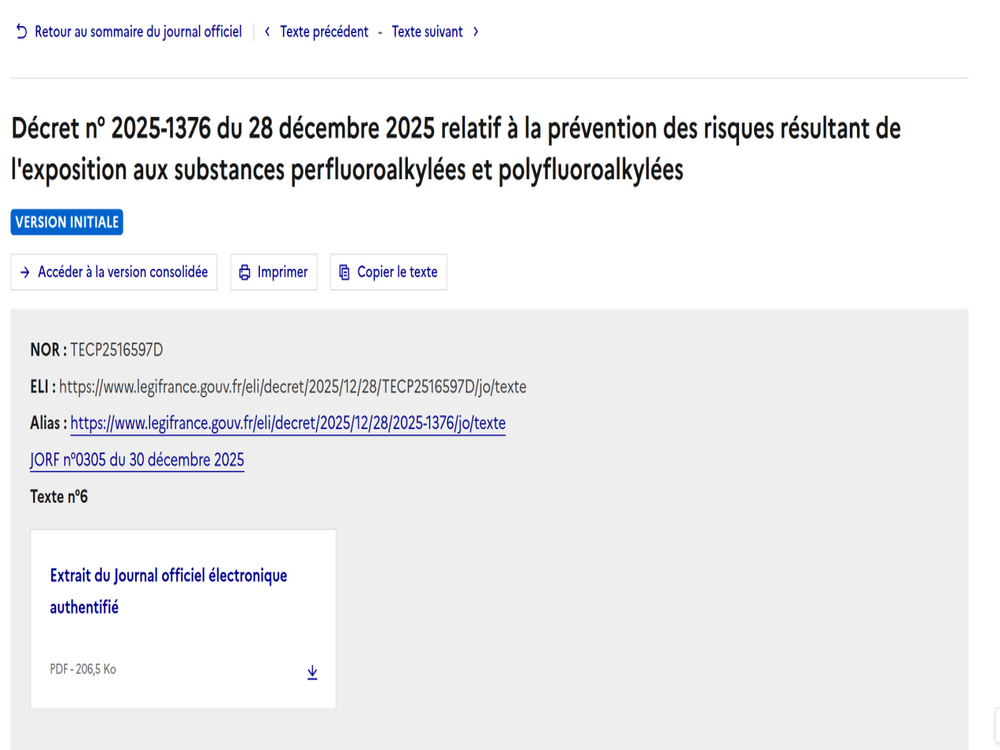
France introduced one of the most significant changes on January 1, 2026, restricting consumer clothing, footwear and related waterproofing products containing PFAS above defined residual thresholds. For polymer-containing PFAS, the residual threshold is set at 50 ppm.
At EU level, the REACH restriction on PFHxA, its salts and related substances will apply to consumer apparel, accessories and footwear from October 10, 2026. The limits are 25 ppb for the sum of PFHxA and its salts, and 1,000 ppb for PFHxA-related substances in homogeneous materials.
The regulatory push is not limited to chemistry.
From July 19, 2026, large companies in the EU are prohibited from destroying unsold apparel, clothing accessories and footwear, while medium-sized companies will come under the same rule in 2030. The European Commission estimates that around 4% to 9% of textile products placed on the European market are destroyed before use.
One day later, on July 20, the EU Digital Product Passport Registry went live. This does not mean every garment already needs a DPP, but the infrastructure is now in place and the direction is clear: product information is expected to become more structured, interoperable and traceable across the supply chain.
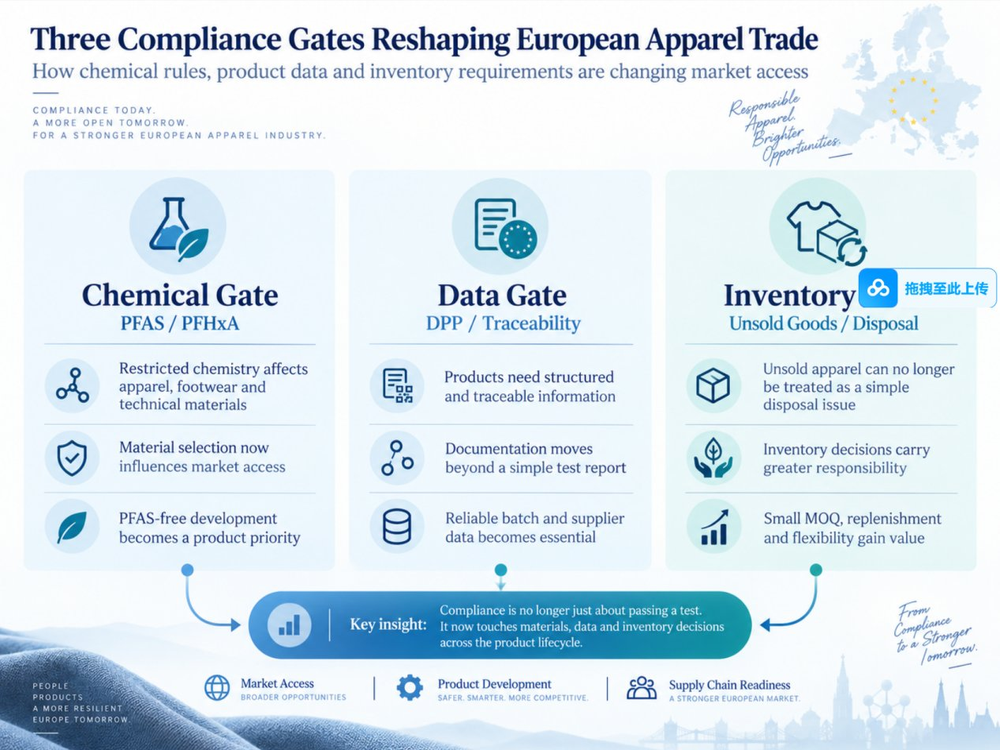
Three different rules, three different business pressures: materials, information and inventory.
The first gate is chemical: materials now affect market access
PFAS regulation matters most in product categories that rely heavily on water repellency, stain resistance and technical finishing.
That puts sportswear, outdoor apparel and functional outerwear directly in the spotlight.
A shell jacket may involve a membrane, DWR treatment, seam tape, coatings and several other performance components. Each layer adds another compliance question.
Europe does not have one single PFAS rule.
The EU's current REACH restriction targets PFHxA and related substances. France has already moved further with a broader national PFAS regime for consumer clothing and footwear.
So for brands, "EU compliant" is no longer always specific enough.
They need to know exactly where the product will be sold.
So PFAS-free and fluorine-free development is moving from a sustainability option to a practical product-development priority.
But replacing fluorinated chemistry is not a simple material swap.
Water repellency, breathability, hydrostatic pressure, durability after washing, hand feel and cost all have to be rebalanced.
For functional apparel, that means a new technical race is already underway.
Technical outerwear can carry PFAS exposure across several material layers, making chemical compliance a product-development issue rather than a final-stage testing issue.
The second gate is data: products need evidence, not just claims
A DPP puts a QR code on the garment, but the code is only the doorway.
What matters is the product data behind it.
The Digital Product Passport is designed to support compliance and product information across the Single Market. The exact data requirements for textiles are still being developed, so it would be premature to treat every field as fixed today.
But the direction is already clear.
Brands will need structured information on materials, components, production records and supporting documentation.
For suppliers, this changes what "traceability" means.
A fabric mill may once have been asked for a specification sheet and a test report.
Going forward, brands are likely to expect more consistent batch-level records, supplier documentation, material composition data and digital files that can move with the product.
The scarce capability is shifting from a one-off certificate to something harder to fake:
"Can you show me a certificate?"
It is now:
"Can you keep producing reliable data, season after season?"
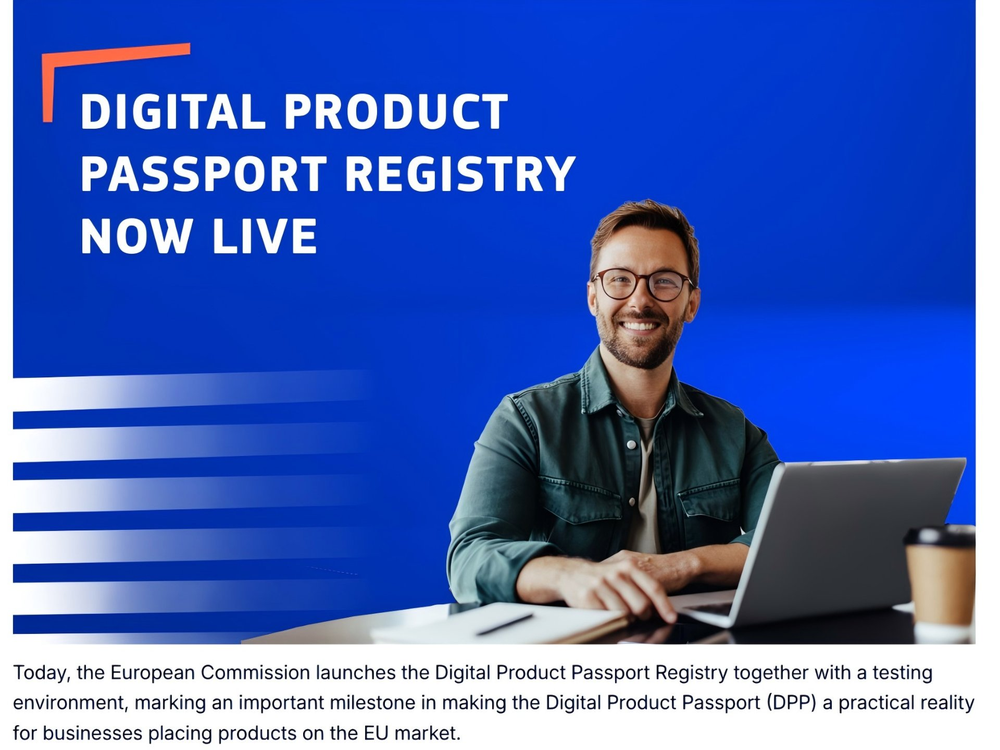
Compliance is moving from a final test report toward a continuous digital record that follows the product across the supply chain.
The third gate is inventory: overproduction now carries a regulatory cost
The ban on destroying unsold clothing may look like a waste-management rule.
In reality, it can reach all the way back to sourcing.
If disposal becomes more restricted, brands have to think more carefully about initial order size, replenishment and inventory exposure before production starts.
The old model was relatively simple:
forecast → produce → discount → dispose
That model is harder to defend now.
The EU now requires large companies to keep unsold products in use where possible, through resale, reuse or other approved routes, rather than destruction.
That gives more value to supply-chain capabilities such as:
Small MOQ ` Quick Replenishment ` Flexible Capacity ` Late-stage Differentiation
In the past, these tools were mainly about commercial agility.
Now they are also part of inventory-risk and compliance management.
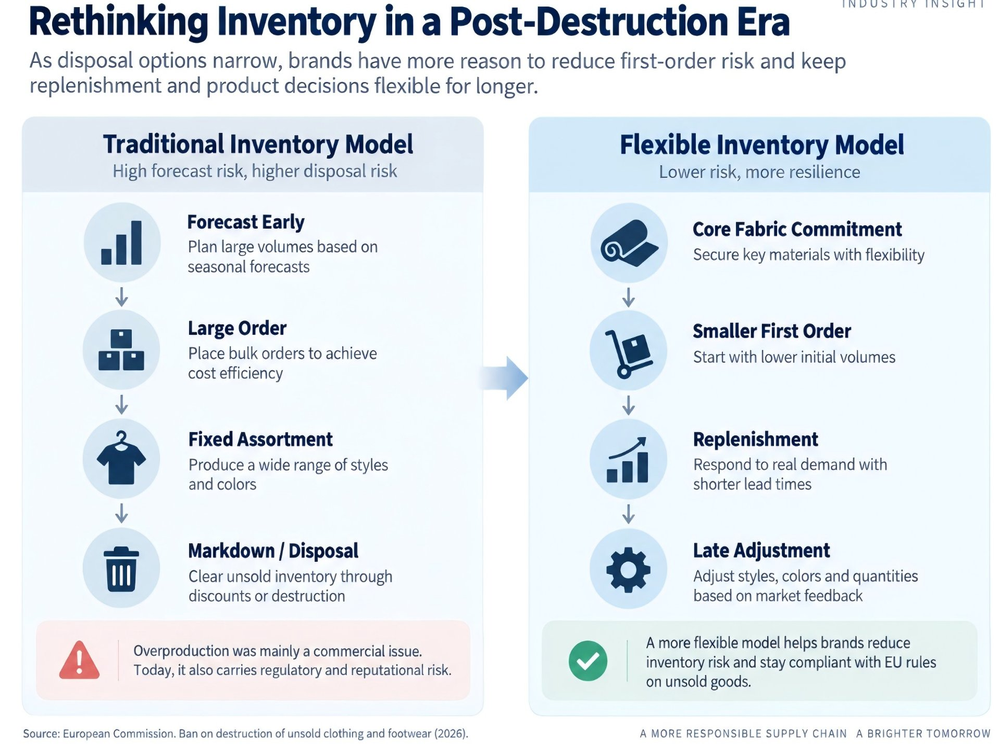
As disposal options narrow, brands have more reason to reduce first-order risk and keep replenishment and product decisions flexible for longer.
Why functional apparel feels the pressure first
Basic apparel is not affected in the same way as technical clothing.
A performance jacket may combine a shell fabric, membrane, coatings, adhesive tape, synthetic trims and several other functional materials.
The more complex the product, the more complex the compliance chain.
So one of the old competitive questions in outdoor apparel is changing.
It used to be:
Who performs better?
Now it is about who can deliver the same performance within a tighter chemical and traceability framework.
That creates a real opportunity for suppliers and material developers.
A fluorine-free solution that still delivers strong water repellency, breathability and durability — without new compliance concerns — turns a regulatory requirement into a product advantage.
For functional brands, that is exactly the edge worth designing for.
The supplier's role is changing too
Brands cannot manage this transition alone.
The compliance chain runs through yarn suppliers, fabric mills, membrane suppliers, dyeing and finishing partners, trim suppliers, garment factories and testing labs.
If one link cannot provide reliable evidence, the risk sits with the final product.
That changes the supplier scorecard.
Price, quality and delivery still matter.
But brands now also weigh:
Chemical Management ` Traceability ` Certification Support ` Data Readiness
Compliance is starting to sit in front of the commercial conversation.
If the product cannot meet the rules, there may be no price discussion at all.
The EVER GLORY view: build compliance into development, not after production
At EVER GLORY, we have spent years working with international apparel brands and building deeper capabilities in sportswear, outdoor and functional apparel ODM.
From our perspective, the biggest lesson from Europe's new rules is simple:
compliance has to start earlier.
If a technical fabric depends on high-risk chemistry from the beginning, trying to solve the problem after bulk production is usually the most expensive route.
A better approach is to bring compliance into product definition.
That means screening PFAS-free materials early, validating fabric performance, keeping supplier and batch records, and involving testing and certification partners before the product is locked.
For brands selling into Europe, our role is to help answer practical questions during development:
Is there a compliance risk in this material?
Is there a more mature fluorine-free alternative?
If the chemistry changes, does the garment structure need to change too?
Can the supply chain provide enough evidence to support the product?
These may look like compliance questions.
Those are product-development questions at heart.
We read regulatory change as a design constraint that can open new competitive space, not merely a cost.
When everyone has to work inside a new set of rules, the companies that adapt earlier have more room to differentiate.
For apparel suppliers, the question is moving from:
"Can you make it?"
to:
"Can you make it, prove it, trace it — and still make it better?"
Over the next few years, that will be one of the clearest dividing lines in European apparel sourcing.

 EN
EN