Vietnam's textile and garment exports were estimated at $35.721 billion in January–September 2026, up 3.3% year on year, according to VITAS figures cited in October industry reports. Export value continued to grow, but the figures do not establish a broad recovery in order volumes or profitability.
Garment exports reached an estimated $28.237 billion, up 2.2%, accounting for 79.0% of the sector total. Fibres and yarns rose 13.08% to $3.605 billion, while nonwoven fabrics increased 7.77% to $610 million. These categories grew faster than garments in value terms. That does not, by itself, show that Vietnam has expanded the weaving, dyeing and finishing capacity needed by garment factories, or reduced their dependence on imported fabrics.
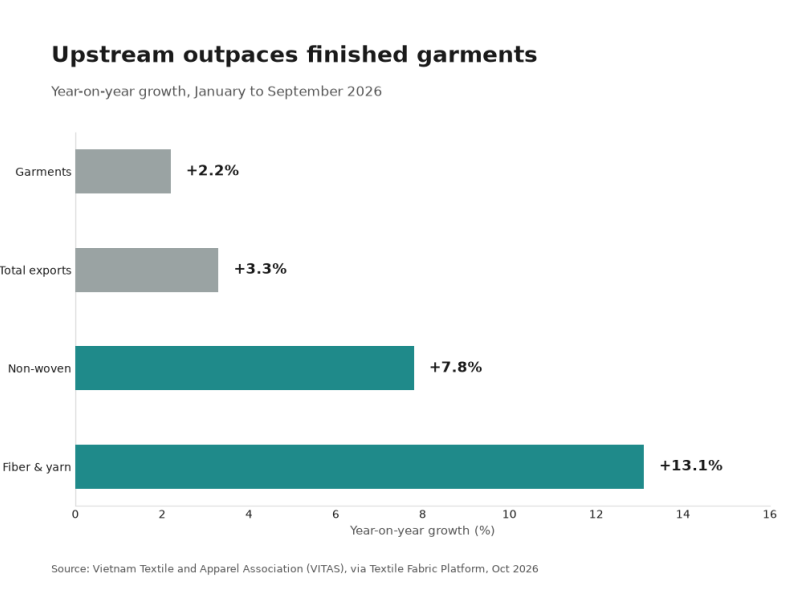
Garments accounted for 79.0% of January–September export value. Source: October 2026 reports citing VITAS.
Earlier market data show an uneven picture. VOV's July 7 report, citing VITAS, used January–May figures for export destinations: shipments to the EU reached $1.94 billion, up 8.8%, while Japan and South Korea declined 6.2% and 8.9%, respectively. These figures cover a shorter period than the nine-month sector total and should not be read as the latest market breakdown.
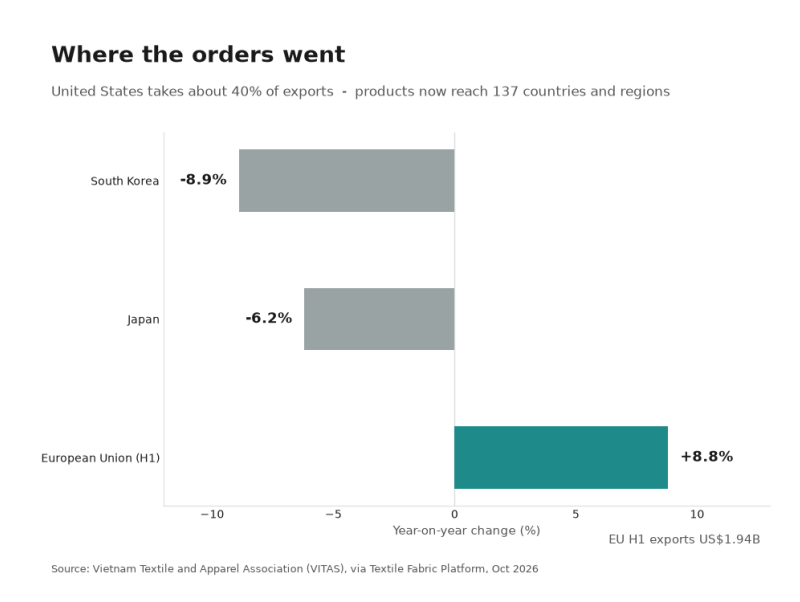
EU growth and declines in Japan and South Korea refer to January–May 2026. Source: VOV, July 7, 2026, citing VITAS.
For suppliers, the implication is to plan against customer-level demand rather than assume that national export growth will translate into fuller production lines. Different destination markets bring different seasonal calendars, price expectations and compliance requirements. Capacity allocation needs to reflect confirmed orders and material readiness.
The US tariff comparison requires care. Vietnam's Ministry of Industry and Trade reported that a Section 301 measure took effect on July 24, 2026, with an additional 12.5% duty on covered Vietnamese goods. This is not a uniform total tariff on all textile products. Ordinary duties and exclusions must also be checked for the relevant tariff classification. Comparisons with competitors need to use the same product and applicable treatment, including any quota eligibility.
For a buyer, the commercial question is the landed cost of a specific garment. Freight, payment terms, defect rates and the cost of changing suppliers also matter. A tariff disadvantage can increase pressure on FOB prices, but its effect on a factory's margin depends on the contract and how the additional cost is shared.
Higher-value work is a practical direction for manufacturers, but a higher selling price does not guarantee a better margin. Technical garments can require more demanding fabrics, tighter process control and additional testing. Investment in automation, energy efficiency or wastewater treatment needs to address a production bottleneck, a compliance requirement or a measurable operating cost.
Faster growth in fibre and yarn exports does not establish domestic fabric self-sufficiency. Source: October 2026 reports citing VITAS; interpretation by Ever-Glory.
The $48 billion full-year export target cited in October reporting would require another $12.279 billion in the fourth quarter, or an average of about $4.093 billion a month. This is the pace needed to meet the target, rather than a forecast of confirmed shipments.
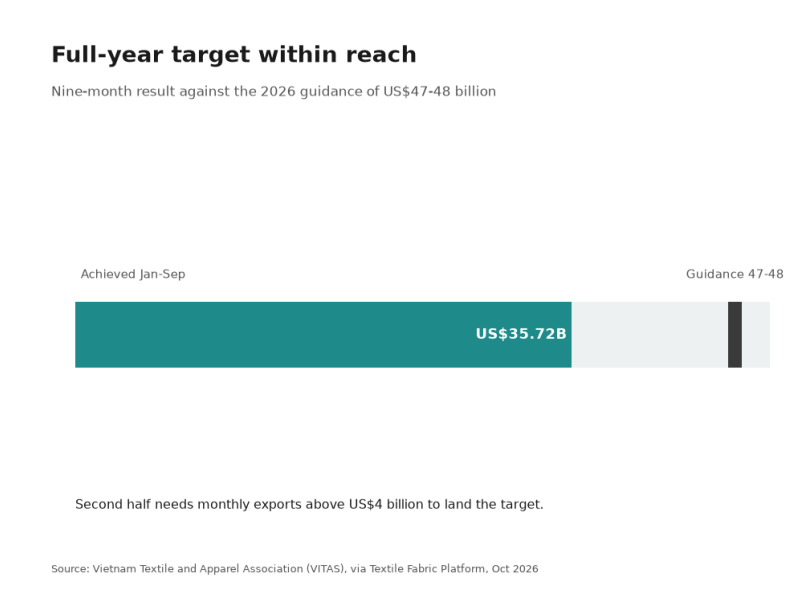
Nine months in, the guidance needs more than $4 billion a month through December. Source: VITAS, October 2026.
At factory level, reliable delivery starts before cutting. Fabric construction, colour approval, shrinkage, colourfastness and any required functional testing need to be resolved early enough for bulk production. A fabric change after approval can trigger repeat testing and disrupt the production schedule.
Closer coordination between sourcing, development and production can reduce avoidable waiting time. It cannot remove mill lead times or testing requirements. Suppliers should track the time from fabric submission to approval, the number of resubmissions and whether bulk fabric matches the approved standard. Those measures show whether local support is improving delivery performance.
For Ever-Glory, the priority in Vietnam is to strengthen the connection between product development and production. Additional capacity is useful only when materials, approvals and delivery commitments can be managed consistently.
Our first Vietnam plant opened in 2005, followed by a second in 2009. In 2026, we added an on-site showroom to support customer reviews of products and development work. We plan to establish a trading company and sample centre in the first half of 2027, followed by the development of local fabric sourcing.
The sourcing plan is intended to complement our existing Chinese supply base. Technical fabrics will continue to be selected according to product requirements and supplier capability. Where suitable materials are available locally, proximity may simplify sampling and communication. Any alternative must still meet the buyer's performance, quality and traceability requirements before it is approved for bulk use.
We will assess the benefit through approval lead times, sample accuracy and on-time delivery. A local sourcing arrangement needs to improve those results without adding quality risk or unnecessary inventory.
The next stage of competition will test both sourcing economics and factory execution. Three areas deserve attention.
First, product-level landed costs. Changes in tariff treatment, freight and commercial terms can alter the attractiveness of a Vietnam-origin programme. Order retention will also depend on whether an alternative supplier can meet the same quality and delivery requirements.
Second, the performance of local development support. The planned trading company and sample centre should be judged by their ability to resolve material questions earlier and reduce repeated approvals, while maintaining clear responsibility for testing and quality.
Third, the financial return from more demanding orders. Growth is useful when the contribution from each programme covers its development, compliance and production costs and converts into cash. For manufacturers investing in Vietnam, that is a more useful test than export growth alone.

 EN